
Why SMS Metrics Matter for Your Community
SMS messaging is a high-impact channel for nonprofits and educational organizations, offering near-perfect open rates of 98% and response times as fast as 90 seconds. These metrics far surpass email, making SMS ideal for urgent appeals, event reminders, and community updates. But raw numbers only help if you track the right KPIs. By monitoring delivery, engagement, and conversion metrics, organizations can refine their messaging, improve participation, and build stronger supporter relationships. For teams managing events or fundraising campaigns, understanding these metrics transforms communication from guesswork into a strategy that drives real results.
Start With the Basics: Delivery Rate and List Health

Before measuring open rates or conversions, confirm your messages actually reach people. Delivery rate — the percentage of sent messages that arrive on a recipient's device — is the foundation of any SMS campaign. The calculation is straightforward: divide delivered messages by total sent, then multiply by 100.
For nonprofits and charities, the industry benchmark sits at an impressive 98–99%. That near-perfect baseline means nearly every message has a chance to engage supporters. But when delivery drops below that range, it usually points to one of three problems: invalid or inactive phone numbers, carrier or recipient blocking triggered by spam-like content, or compliance gaps such as messaging someone who never opted in.
Clean Lists and TCPA Compliance Deliver Results
Improving delivery starts with list hygiene. Regularly remove bounced numbers and inactive subscribers who haven't engaged in months. Avoid repetitive language that resembles spam, and always secure explicit permission before texting — this keeps you compliant with the Telephone Consumer Protection Act (TCPA).
Evant.app helps organizations maintain list health automatically. Its analytics dashboard surfaces delivery stats in real time alongside RSVP and engagement data, so you can spot issues quickly. Instead of piecing together metrics from multiple tools, you get one view of who received your message, who replied, and who showed up — making it easier to keep your list clean without extra manual work.
Open and Response Rates: Gauging Immediate Engagement
With a 98% open rate for nonprofit communications, SMS stands alone as the most reliable channel for getting your message seen within minutes. That near-perfect readership is not just a vanity metric—it means an event reminder, volunteer call, or time-sensitive appeal will land in front of your supporters before they close their phone. The challenge lies in what happens next: the message landed, but did it drive action?
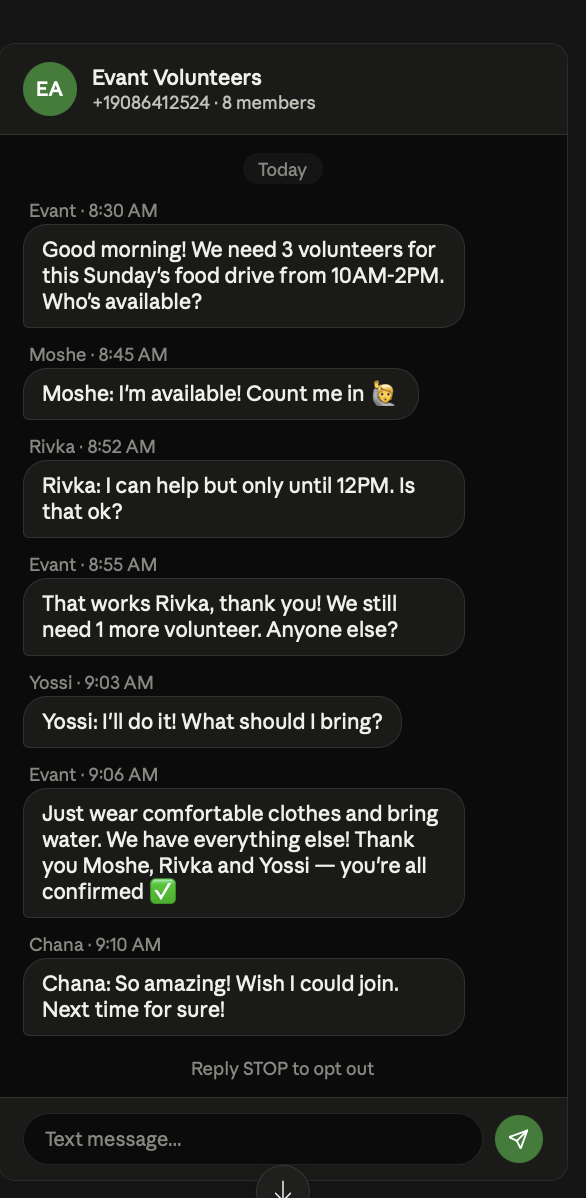
That next step is response rate —the percentage of people who replied to your text. For nonprofits and community organizations, the average response rate falls between 18% and 28%. Unlike open rate (which measures passive reading), response rate captures active engagement. A supporter who types back "Yes" to an RSVP invite or "Count me in" to a volunteer shift has crossed from spectator to participant.
Response times in SMS are measured in seconds—the average reply comes within 90 seconds of delivery. This speed opens up real-time coordination that email simply cannot match: last-minute venue changes, urgent sign-up needs, or just-in-time reminders become logistical advantages rather than chaos. When organizers can trust that 20% of a list will reply within two minutes, scheduling shifts and confirming attendance become near-instant tasks.
Evant.app's platform lets you compare these metrics across every campaign you send—spotting which days and which message styles push your own response rates above the normal 18–28% zone.
Click-Through and Conversion Rates: Driving Action
While open rates confirm your message was seen, click-through rates (CTR) reveal whether your content inspired action. CTR is calculated by dividing the number of link clicks by total delivered messages. For nonprofits, the average CTR falls between 8% and 12%, a range that far exceeds email marketing benchmarks and underscores SMS's ability to drive engaged audiences to donation pages, event registrations, or volunteer sign-ups.
Conversion rate takes this further, measuring how many recipients completed a desired outcome such as making a donation or RSVPing for an event. Nonprofit conversion rates typically land between 0.5% and 1.2%, which may seem modest but represents highly valuable actions from a channel with near-perfect reach and immediate response times.
Improving CTR and Conversions Through Smarter Messaging
Improving these metrics starts with clear calls to action that tell subscribers exactly what to do next. Personalization also plays a major role—addressing recipients by name and tailoring content based on past engagement consistently lifts both CTR and conversion rates. Audience segmentation sharpens this further: supporters who have attended previous events are far more likely to click through for a new invitation than those who haven't engaged in months.
Evant.app provides real-time analytics that track both CTR and conversion behaviors per campaign, so organizers can identify which messages drive the most RSVPs and donations while refining their approach for future sends.
Opt-Out and Churn Rates: Keeping Your Audience Engaged
Opt-out rate is a direct measure of audience satisfaction. When someone unsubscribes, they are telling you the messages no longer feel worth their time. For nonprofits, a healthy opt-out rate sits between 0.2% and 0.6% per campaign — meaning nearly everyone who opted in continues to see value in what you send.
What Drives People to Unsubscribe
The most common reasons people opt out of text messages are receiving too many messages (73%) and receiving the same message too many times (69%). Frequency fatigue and repetitive content signal that the sender has not segmented their list or tailored their cadence to each subscriber's interests. Other culprits include irrelevant offers, poor timing, and a lack of personalization — all of which make the channel feel like noise rather than value.
For community organizations running events, this often looks like blasting every announcement to the full list instead of targeting only the segments that care about a specific fundraiser or volunteer shift. The result is a slow bleed of engaged supporters who simply tune out.
Keeping Churn Below 2%
A churn rate below 2% is widely considered healthy for SMS programs. Staying under that threshold requires intentional list management: set clear expectations at opt-in (what subscribers will receive and how often), use segmentation to send relevant content to each group, and test different send frequencies until you find the sweet spot for your audience.
Evant.app simplifies this by letting organizers segment subscribers by event type, attendance history, or engagement level — so a weekly club meeting reminder never reaches someone who only signed up for the annual gala. Its analytics dashboard tracks opt-out trends in real time, making it easy to spot when a particular message or cadence drives unwanted unsubscribes before it becomes a pattern.
Evant.app also supports automated re-engagement campaigns: if a subscriber has not responded in several months, you can send a single "still interested?" message instead of letting them sit on your list until they eventually opt out. This proactive approach keeps your list clean and your churn rate well within the safe zone.
List Growth and Subscriber Quality

List growth rate measures how quickly your subscriber base is expanding. Calculate it by dividing the number of new subscribers in a given period by your total list size, then multiplying by 100. A healthy growth rate signals that your outreach is resonating and your opt-in process is frictionless.
Steady, consistent acquisition matters far more than single campaign spikes. A one-time burst from a viral post often brings disengaged or low-quality subscribers who will churn quickly. Programs that sustain momentum through everyday discovery — newsletter footers, website sign-up forms, live event prompts — build a list of people who genuinely want to hear from you.
Best Practices for Building a Healthy SMS List
- Offer multiple entry points: promote your SMS keyword on social media, in email signatures, at the end of events, and on printed materials so subscribers can join wherever they are.
- Set clear expectations at opt-in: tell new subscribers exactly what type of messages they will receive and how often. This reduces surprise unsubscribes and keeps churn low.
- Promote organically rather than relying solely on paid ads or contests that attract one-time sign-ups. Regular mentions in your existing communications create steady list growth over time.
Evant.app supports healthy list building by giving organizers tools to track new sign-ups alongside event RSVPs. When you can see which channels drive the most engaged subscribers, you can invest in what works and drop what doesn't.
How RSVP and Event Metrics Strengthen Participation
For event organizers, attendance metrics tell the real story of engagement. Tracking RSVP confirmation rate, actual attendance rate, and no-show reduction provides the clearest picture of communication effectiveness. These metrics help refine outreach for future events and justify continued investment in SMS-based coordination.
Evant.app's platform delivers real-time reporting and live headcounts that improve event logistics. Instead of waiting days for paper RSVPs or guessing how many people will show up, organizers can see exact numbers as responses come in. This data supports accurate ordering, staffing, and room setup decisions.
Automated reminders sent via text can help boost event attendance. Evant.app's system automates these reminders based on registration triggers, sending follow-ups only to non-responders or specific segments. This targeted approach increases RSVP rates without over-contacting already confirmed guests.
| Metric | What It Measures | Why It Matters |
|---|---|---|
| RSVP confirmation rate | % of invitees who respond yes | Shows message resonance; benchmark above 90% is strong |
| Attendance rate | % of confirmed guests who actually attend | Reveals friction in check-in process or commitment strength |
| No-show reduction | % drop in absentees after using SMS | Directly correlates with cost savings on supplies and venue |
Calculating ROI and Justifying Your SMS Investment
The return on investment (ROI) from SMS is measured by comparing the revenue generated to the total campaign cost. For every $1 spent, SMS campaigns deliver an average return of $16.70 to $71. An easy way to calculate your own ROI is to use the formula: subtract the total campaign cost from the attributed revenue, divide that number by the campaign cost, and multiply by 100 to get a percentage.
Real-world examples show what's possible: Oz Mobiles integrated SMS with its Shopify store and achieved a 3,000% ROI by using analytics to track conversions and optimize send times based on customer behavior. The Spokesman-Review ran a targeted win-back campaign using timely SMS reminders a few days before payment expiration—replacing previous email-only outreach—and reduced involuntary churn by 82 percent, delivering a 38x return on investment.
Tying SMS to Nonprofit Outcomes
For nonprofits, ROI may not always mean direct donations. A coaching text that inspires a participant to raise an additional $100 or a reminder that reactivates a lapsed fundraiser generates real value that won't appear as text-attributed revenue. Mission-focused organizations can measure success through retention lift (comparing churn rates before and after adding SMS), first-party data collection (building owned audience profiles), and event attendance lift.
Evant.app's analytics dashboards help organizations tie every message to concrete outcomes such as RSVPs, check-ins, and donations—giving you the numbers needed to justify continued investment.
Cost Considerations for Event Texting
Event text messaging is rarely free, but the investment is small compared to the results. Most platforms charge per message or require a monthly subscription. Costs range from a few cents per message to subscriptions starting around $19 per month.
Pricing Models and Discounts for Nonprofits
Per-message pricing suits low-volume senders, while flat-rate subscriptions work better for organizations sending frequent campaigns. Some providers offer a free tier with a limited number of messages per month, and others provide discounted rates or in-kind grants for eligible nonprofits.
ROI Justifies the Upfront Investment
Even with paid plans, SMS delivers exceptional value. With a 98% open rate and response times averaging 90 seconds, a single campaign can drive donations, event registrations, and volunteer sign-ups that more than cover the cost. Flexible SMS engagement and analytics tools can help organizations track that return.
Turning Metrics Into Action: A/B Testing and Optimization

Collecting metrics matters little if you never act on them. The real power of SMS analytics lies in using data to refine every message you send — and A/B testing is the fastest path to improvement.
What to test first
Three variables drive most SMS engagement gains: timing, call-to-action wording, and message length. By running controlled tests — sending variant A to half your list and variant B to the other half — you isolate which element actually moves the needle. For example, Boston Proper tested send times and saw a 13% increase in click-through rate, a 10% rise in conversion rate, and a 10% bump in revenue per message. Those results came from one change: shifting when the text landed.
From data to decision
The best SMS platforms pull testing results into a dashboard so you can compare delivery rate, CTR, response rate, and opt-out rate side by side. Over several rounds of A/B tests, patterns emerge — Tuesday mid-morning outperforms Friday evening; a CTA using "RSVP now" beats "Learn more"; messages under 120 characters get more replies. Apply those findings to your next campaign and track whether benchmarks improve.
Closing the loop with CRM data
A/B testing inside your messaging platform tells you what works at the message level. But integrating that SMS data with your CRM — whether Salesforce or HubSpot — reveals how those wins connect to broader outcomes like retention lift, donation frequency, or event attendance. When your CRM shows that supporters who clicked an SMS link also increased their giving by 20% over three months, you can attribute real value back to a specific message variant. Evant.app's analytics suite tracks RSVP rates, event check-ins, and subscriber-level engagement inside one system — reducing the gap between test results and strategic decisions.
Build Stronger Communities With Data-Driven SMS
Tracking the right SMS metrics shifts your communication from guesswork to a repeatable strategy. Every delivery rate, response time, and conversion tells you what resonates with your audience.
Connecting those KPIs to real outcomes — higher attendance, stronger donations, deeper engagement — turns data into community growth. Start using SMS analytics to understand your supporters better and strengthen every relationship.
Related Blogs